group exhibition
Bending Time
Group Exhibition
Oleg Prokofiev, Valentino Vannini, Kirill Basalaev
Curated by Anzhela Popova
Prokofiev Studio
13 Ramsgate Street, London E8 2FD, United Kingdom
The inaugural exhibition Bending Time at Prokofiev Studio is conceived as a group exhibition structured around the notion of the archive – understood not as a static repository, but as a living, generative system through which artistic legacies are continuously reactivated, reconfigured, and brought into the present. Rather than preserving the past, the archive here operates as a dynamic field of relations, where memory, material, and form remain in a state of transformation.
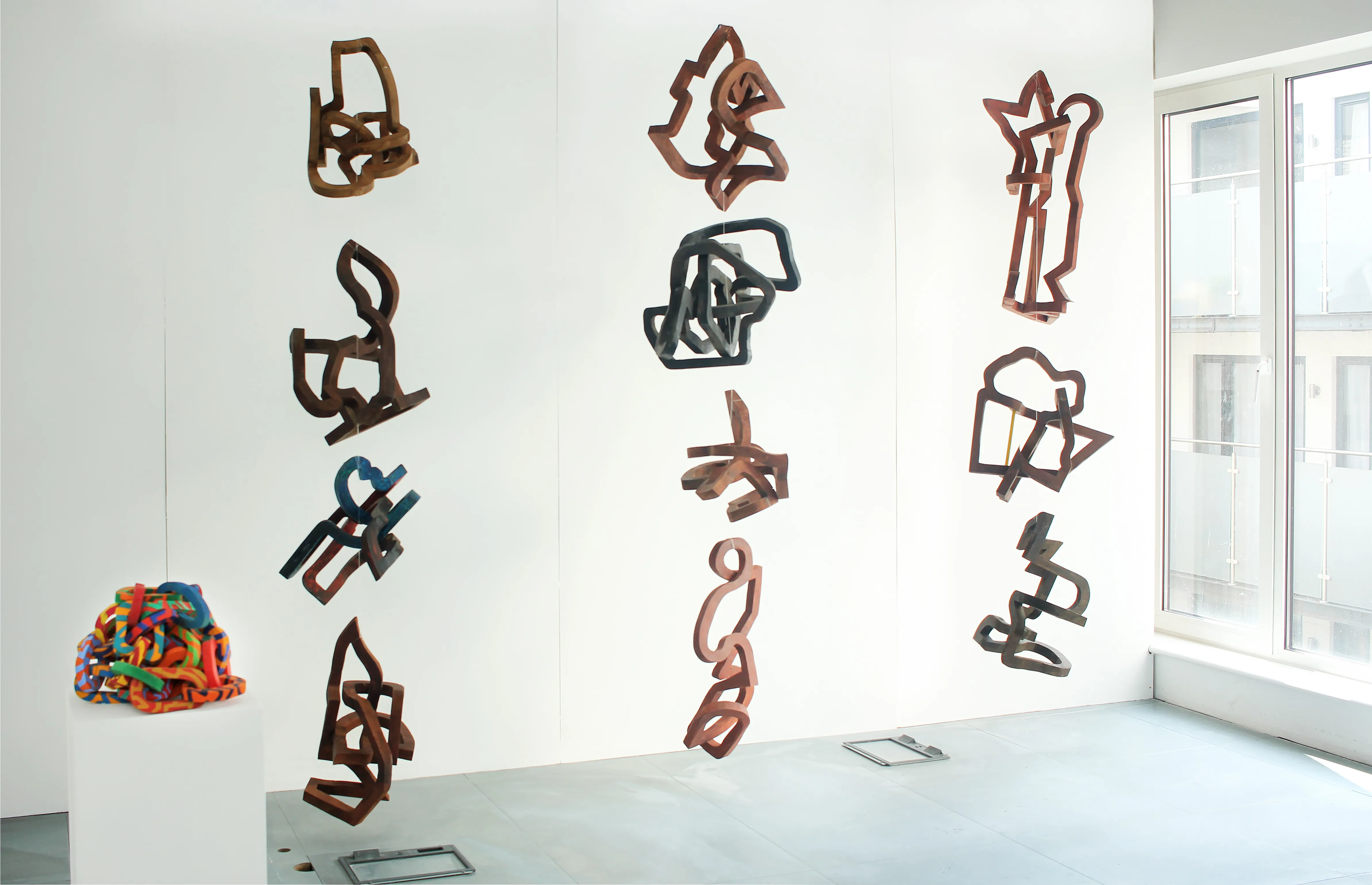
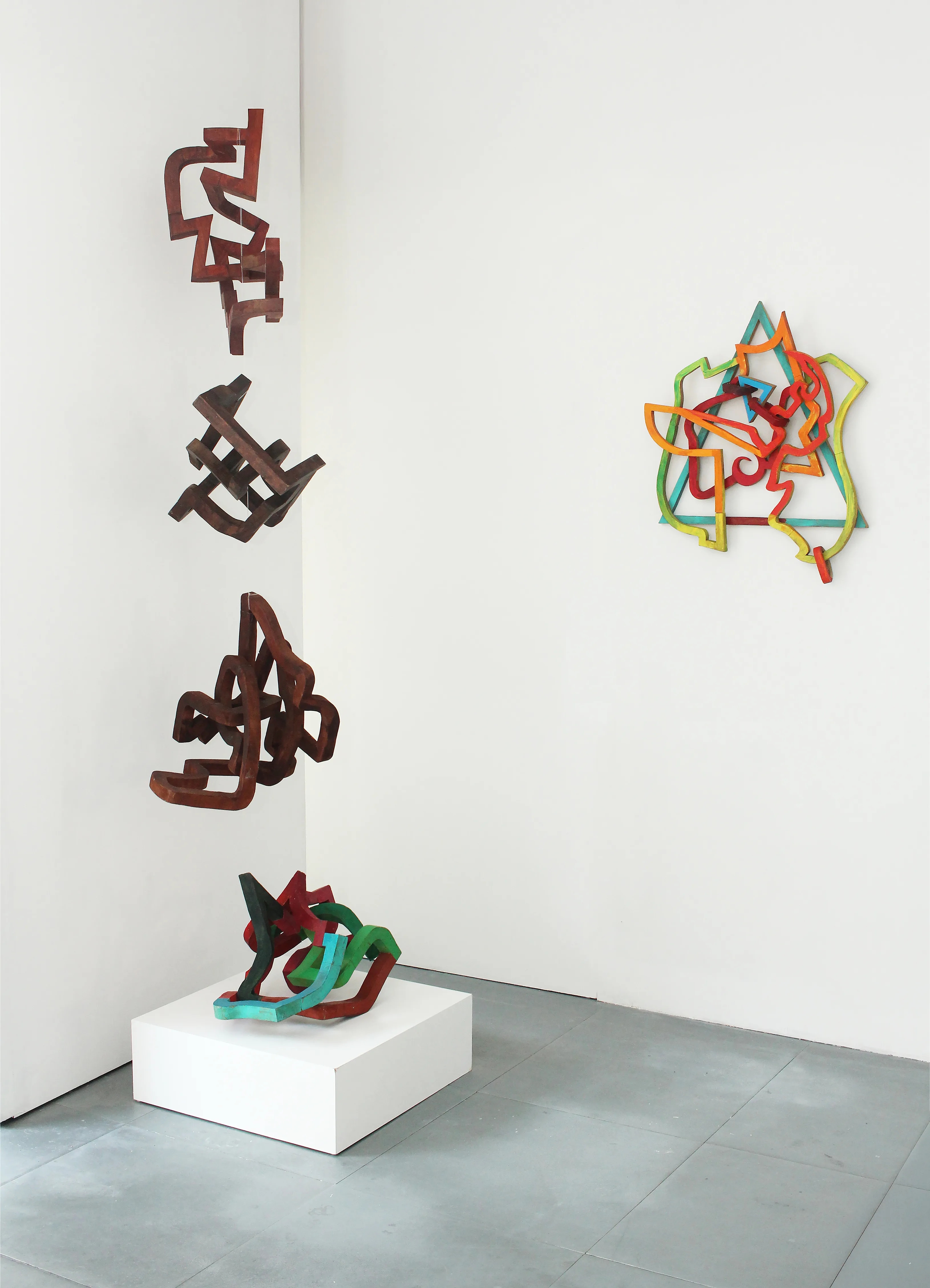
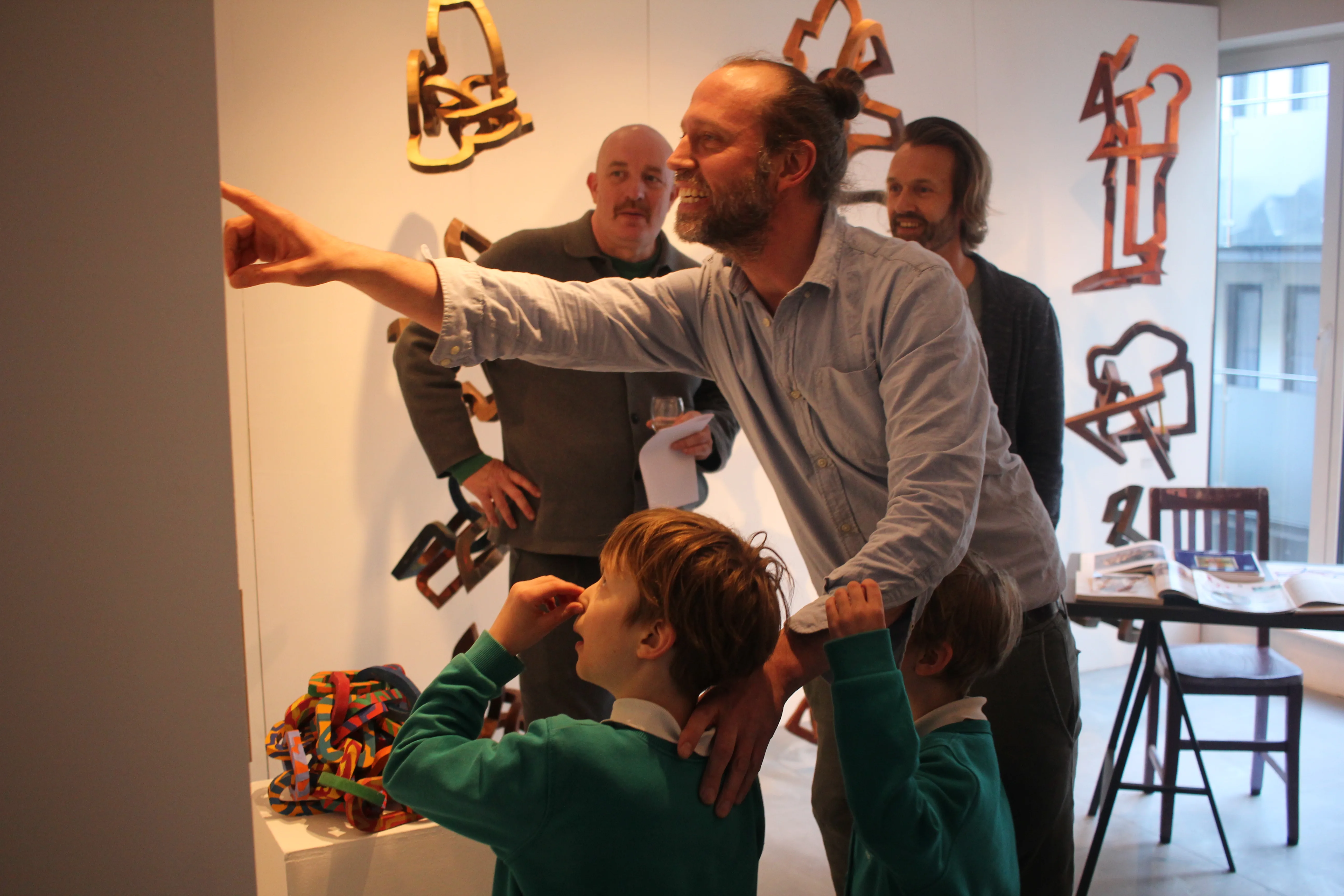
At the core of the exhibition is a reconstruction of Oleg Prokofiev’s studio from the 1990s, originally located on Dace Road in Hackney Wick. This environment is an active spatial framework that reveals the conditions of the artist’s thinking. Within it, a selection of Prokofiev’s wooden sculptures is presented in close proximity to their original context, allowing the viewer to encounter them not as isolated objects, but as part of an ongoing process.
Prokofiev’s works, developed following his experience of New York in 1977–78, are grounded in the principle he described as the “line in space.” Wooden strips condense into knots or container-like forms, extending into chains, garlands, or serpentine structures. Like the “space-modulations” described by Eduardo Chillida, these works do not simply occupy space but actively produce it. The line – thick, tangible, and materially dense – moves freely, yet is bound by a single rule: it must always return to its point of origin. This cyclical movement establishes a crucial conceptual link to the exhibition as a whole, where time, memory, and form are understood as recursive rather than linear.
Despite their physical density, these sculptures generate a powerful sense of internal space. It is the tension between mass and void, containment and expansion, that defines their presence. The works continually reorganise themselves in relation to their surroundings, extending beyond objecthood toward installation, where space itself becomes sculptural. In this way, Prokofiev’s practice establishes a foundational logic for the exhibition: form as a site of negotiation between structure and instability, presence and absence.
This logic extends into the archival materials preserved within the reconstructed studio – documents, manuscripts, photographs, sketchbooks, and ephemera. These elements are not presented as historical evidence, but as active components of the exhibition. As carriers of time, they mediate between past and present, revealing the archive as a process rather than a conclusion. Fragmented and incomplete, they mirror the very structure of memory itself, reinforcing the idea that meaning is continuously produced through reactivation.
The main gallery expands this framework through the work of Valentino Vannini, and Kirill Basalaev. Their practices do not follow Prokofiev’s legacy directly, but resonate with it through shared concerns with materiality, temporality, and transformation. Together, they form a network of affinities in which the archive becomes distributed across bodies, materials, and spatial conditions.
As proposed by curator Anzhela Popova, the exhibition operates through a “return to the future” – a movement that uncovers unrealised potentials of the past while foregrounding possibilities embedded in the present. Within this context, memory is understood not as preservation, but as an active, destabilising force that reshapes perception.
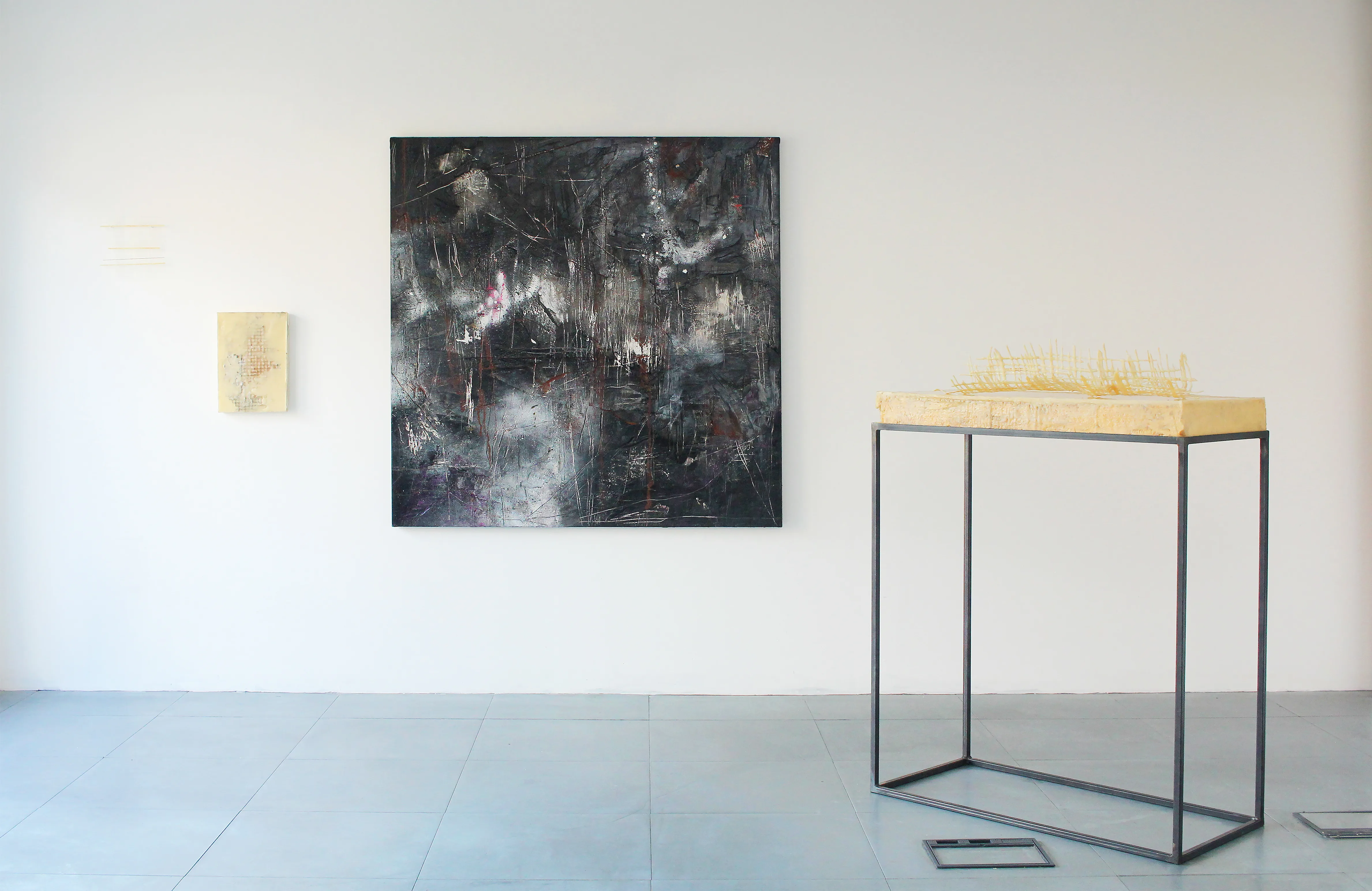
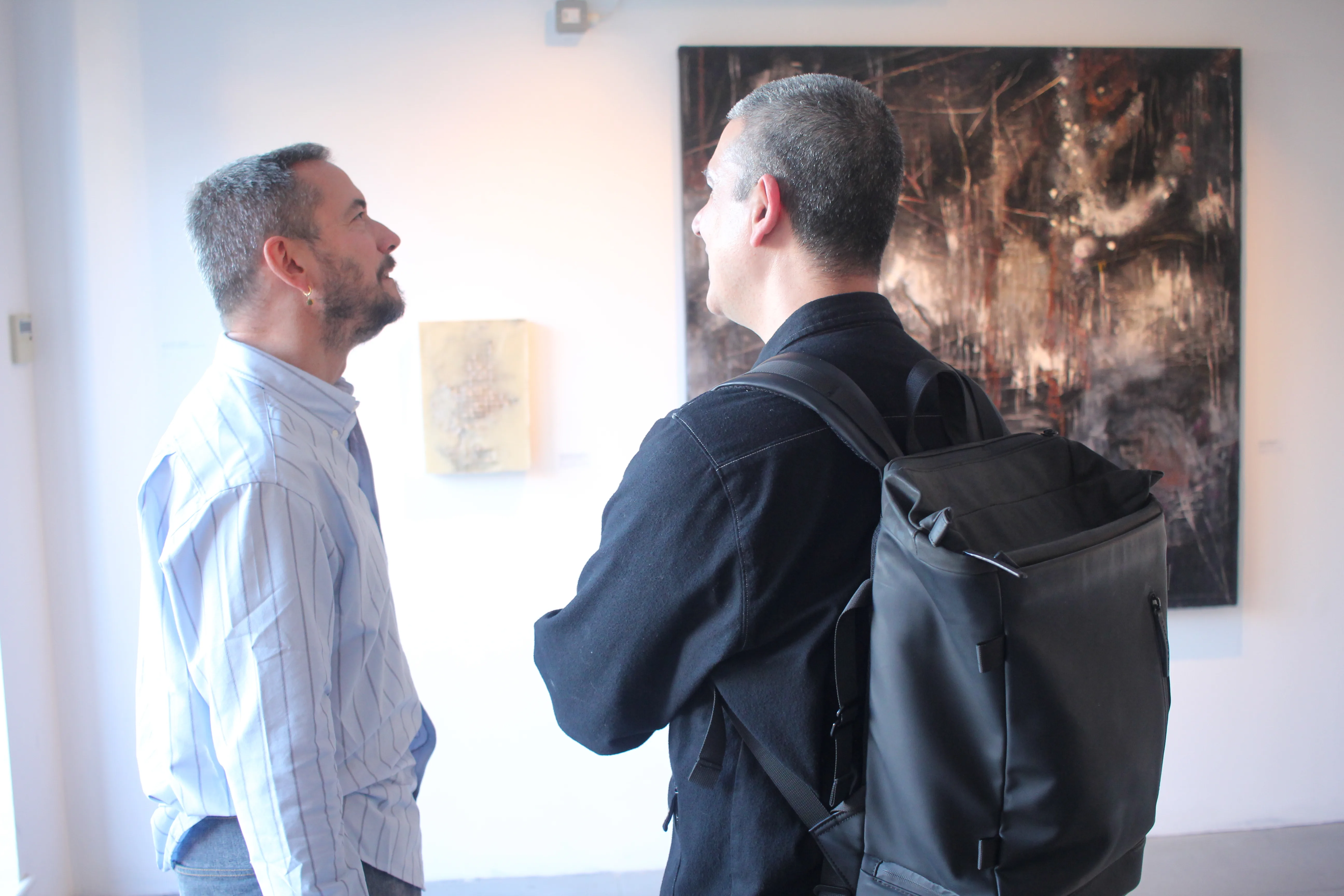
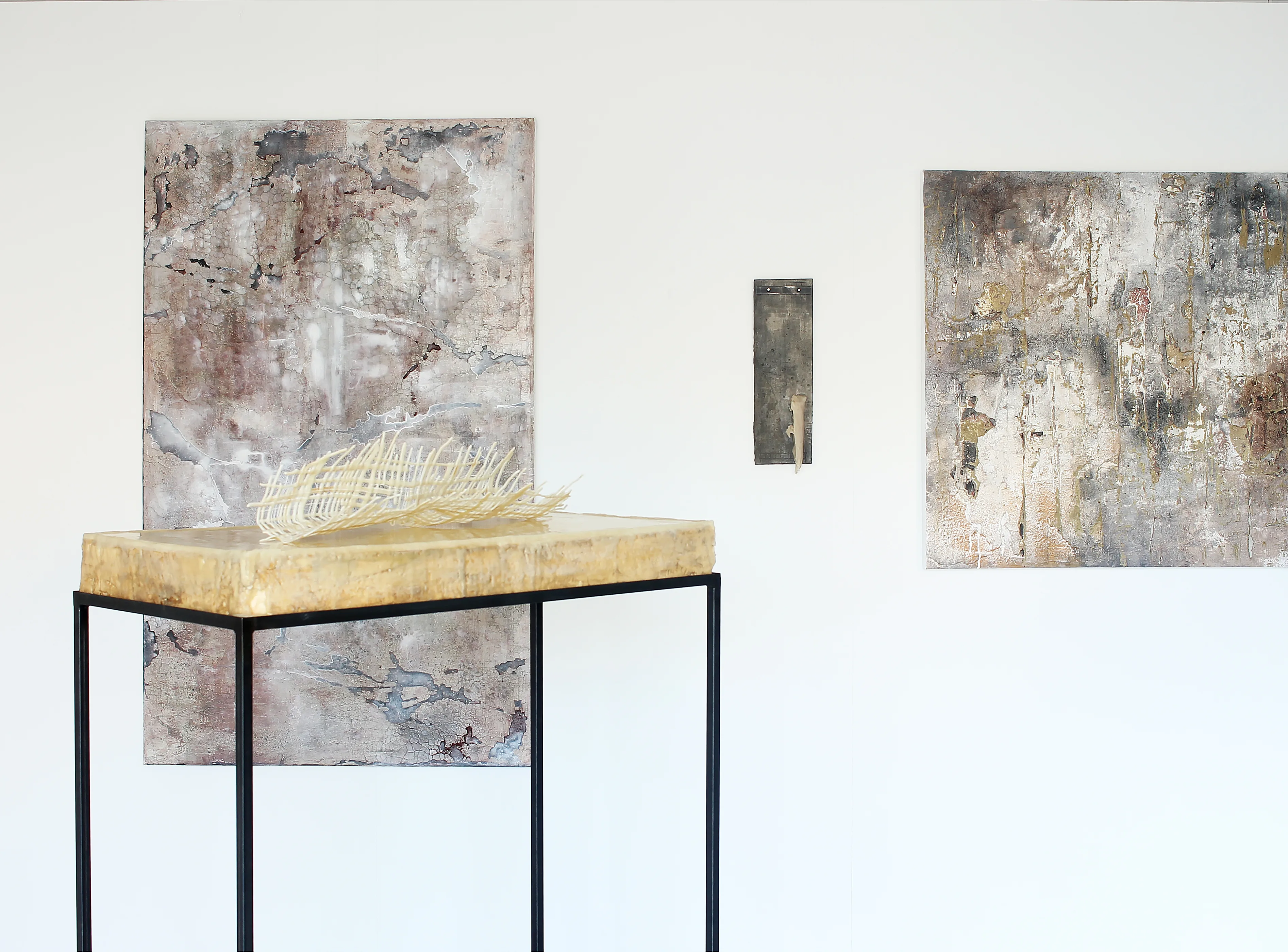
For Kirill Basalaev, cement – typically associated with permanence – becomes a fragile and unstable carrier of memory. His works appear as archaeological imprints: traces of forms that never fully materialised, yet persist as residues of presence. These forms exist outside linear time, suggesting that matter itself holds the capacity to remember. Cracks, scratches, and erosion – drawn from urban surfaces – become metaphors for memory as fragmented and layered. Through this material language, Basalaev extends the exhibition’s central tension between construction and collapse, revealing memory as both a site of loss and a condition for new perception.
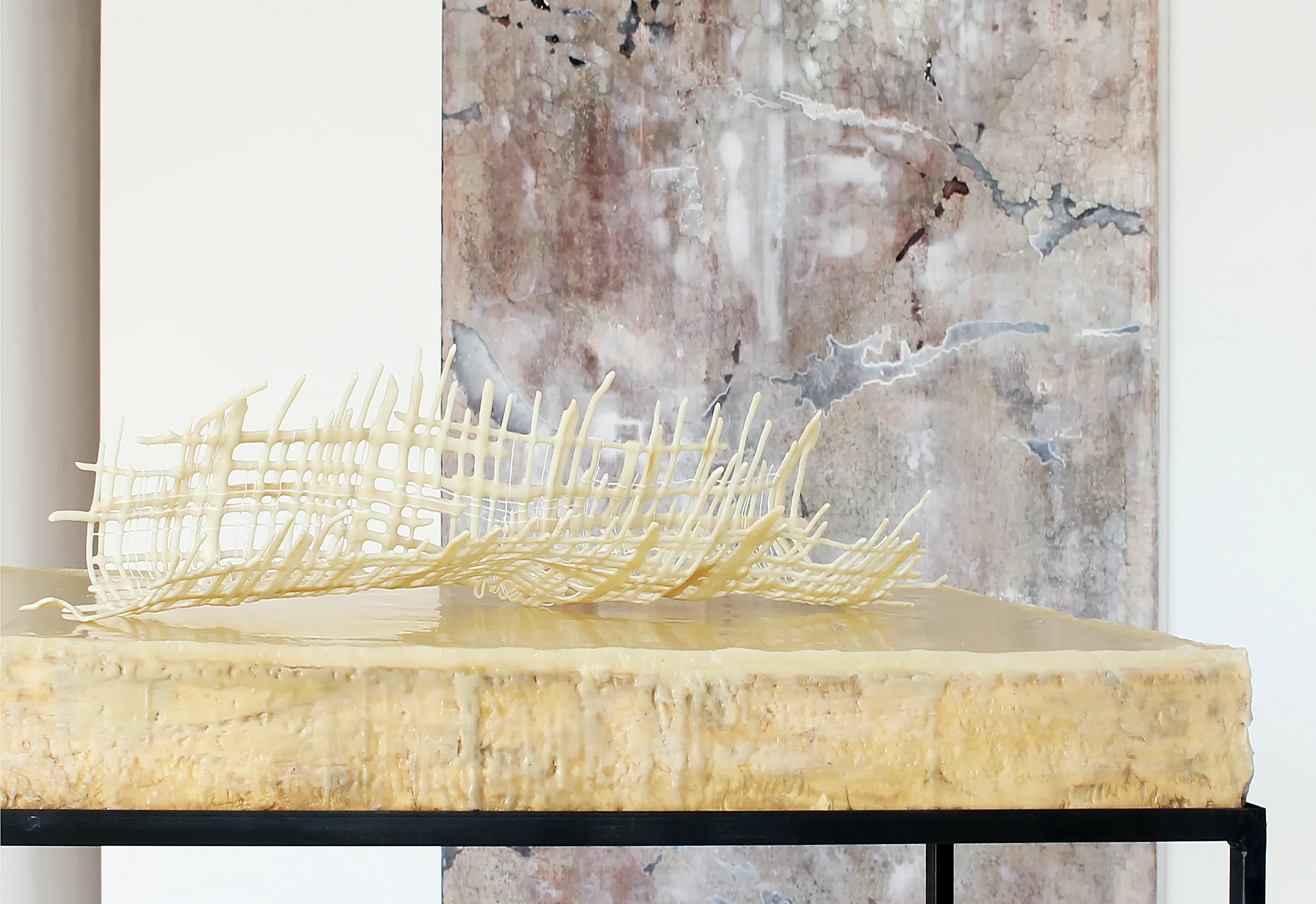
Valentino Vannini’s practice shifts this inquiry toward the immediacy of transformation. If Basalaev’s works hold memory as traces, Vannini’s materials perform change in real time. His multidisciplinary approach creates a sensual field in which materiality resists stability. Reinforced concrete, petroleum jelly, wax, resin, bitumen, fibres, and glass are combined in ways that foreground contradiction: rigid and soft, viscous and solid, enduring and fragile.
These materials echo architectural forms – frameworks, scaffolding, enclosures – but destabilise their logic. Structures sag, stretch, or dissolve into organic configurations, exposing the vulnerability inherent in systems of control. In this way, Vannini’s work enters into dialogue with Prokofiev’s spatial constructions by pushing their internal tensions toward collapse and transformation.
Across these practices, a shared condition emerges: connection is never fixed, but always in flux. Each encounter – between material and form, past and present, body and space – produces something new, shaped as much by absence as by presence. Like Prokofiev’s line returning to its origin, these relations are cyclical, recursive, and continually redefined.
Bending Time thus unfolds as a field of correspondences in which archive, memory, and material are inseparable. What is presented is not a stable narrative, but a shifting constellation of forms and relations – where the past is not recovered, but reactivated, and where meaning remains open, contingent, and in motion.